Con Edison Small Business Lighting Incentives: What Contractors Should Know Before Quoting
- LumaQuote

- May 20
- 14 min read

Con Edison lighting incentives can make a commercial LED retrofit easier to sell, but contractors need to be careful before showing a rebate in the proposal.
For 2026, Con Edison’s Small Business & Nonprofit program says eligible energy efficiency upgrades can receive incentives that cover up to 70% of installation costs, while building electrification incentives can cover up to 50%. However, the 2026 incentive factsheet also says lighting incentives are only available through the Neighborhood Program, which applies to eligible territories. That detail matters before you quote a lighting project.
In plain English: do not assume every Con Edison small business customer qualifies for lighting incentives. Confirm the customer location, account type, program pathway, fixture eligibility, and current incentive rules before you include the rebate in the final number.
For contractors building lighting audits and proposals, this is exactly where a cleaner workflow helps. A tool like LumaQuote’s lighting retrofit software can help organize fixture counts, existing wattage, proposed replacements, utility rates, rebate assumptions, savings, and payback before the proposal goes to the customer.
Quick Answer: How Do Con Edison Small Business Lighting Incentives Work?
Con Edison’s Small Business & Nonprofit program is designed to help small commercial and nonprofit customers reduce energy use with approved upgrades. The customer usually works with a participating contractor, the contractor visits the facility, provides a quote, estimates the incentive, completes the work, and applies the incentive as a discount on the invoice.
For lighting specifically, contractors should pay attention to the 2026 factsheet language. It says the Neighborhood Program continues to offer incentives for lighting, and the lighting section is marked Neighborhood Program Only. These incentives are tied to eligible locations, and they may cover up to 100% of the total eligible cost, but they cannot exceed the total project cost.
Item | What contractors should know |
Main program | Con Edison Small Business & Nonprofit Energy Efficiency and Building Electrification Program |
Lighting availability in 2026 | Listed under Neighborhood Program only in the 2026 incentive factsheet |
General Small Biz incentive cap | Up to 70% of energy efficiency installation costs |
Building electrification cap | Up to 50% of installation costs |
Neighborhood lighting cap | May cover up to 100% of eligible cost, but not more than total project cost |
Key requirement | Lighting must be ENERGY STAR or DesignLights Consortium listed at time of installation |
How incentive is typically delivered | Paid to the participating contractor and passed to the customer as a discount |
That means a lighting proposal should not just say “Con Edison rebate available.” It should clearly state whether the incentive is confirmed, estimated, pending approval, or location dependent.
Who This Program Is For
Con Edison’s small business and nonprofit incentives are aimed at small to medium commercial customers and nonprofit organizations in Con Edison’s service area. The program can support upgrades across several categories, including HVAC, refrigeration, building envelope, heat pumps, domestic hot water, and, where eligible, lighting.
Con Edison says customers should choose a contractor from its approved participating contractor list. If the customer wants to use a contractor that is not listed, the contractor can register with Con Edison.
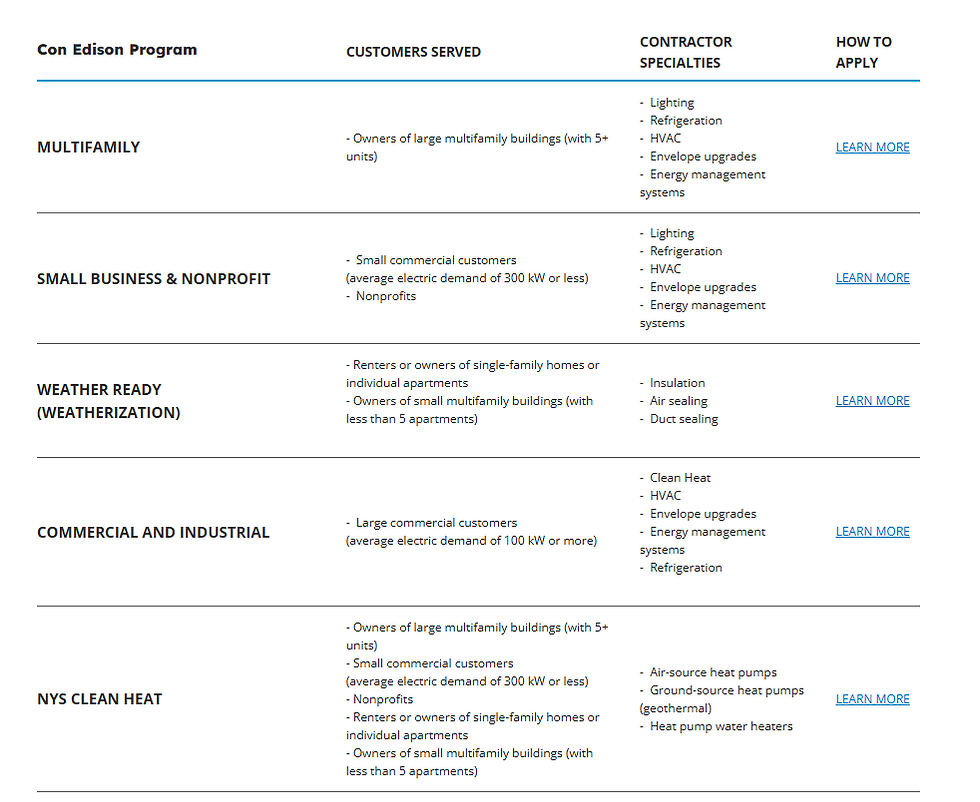
For contractors, that creates two practical questions before quoting:
Is the customer eligible for the relevant Con Edison program?
Are you approved or able to participate through the required contractor process?
Con Edison’s contractor page says participating contractors can take part in both the Small Business & Nonprofit Program and the Small Business & Nonprofit Neighborhood Program. Contractors are asked to review the program manual, incentive fact sheet, and contractor requirements, submit a participating contractor agreement and application, provide a W-9 and certificate of insurance with at least $1 million general liability coverage, and attend an orientation before approval.
That process matters because the incentive is not just a marketing line. It affects how the project is priced, documented, approved, and invoiced.
Why Contractors Need to Be Careful Before Quoting Lighting Incentives
The biggest mistake is treating the incentive as guaranteed before the project is checked against current Con Edison rules.
Con Edison’s FAQ says the exact incentive depends on the equipment installed, building type, total project cost, and whether the customer qualifies for bonus incentives available at the time of application. In many cases, the incentive is based on projected energy savings, which requires calculations.
That means two contractors can audit similar buildings and still end up with different incentive outcomes if:
one site is inside a qualifying Neighborhood Program territory
the other is not
one fixture type is eligible
the other is not
one product is DLC or ENERGY STAR listed at the time of installation
the other is not
one project is approved before work starts
the other starts too early
z
one proposal shows the rebate as estimated
the other shows it as guaranteed without approval
This is why your proposal should separate the gross project cost, estimated incentive, net customer cost, annual energy savings, and payback period. If you need a structure for presenting those numbers, see Lighting Retrofit ROI: How to Calculate Payback and Present It Clearly.
2026 Lighting Incentive Examples From Con Edison’s Factsheet

Con Edison’s 2026 factsheet lists specific lighting incentive amounts for eligible Neighborhood Program projects. These are not blanket guarantees for every small business. They are program-specific incentive values that must be checked against eligibility, project rules, and current funding.
Here are a few examples from the 2026 factsheet:
Existing fixture or lamp type | Example 2026 Neighborhood incentive |
1-lamp 4 ft linear ambient luminaire fixture replacement | $88.00 per fixture |
2-lamp 4 ft linear ambient luminaire fixture replacement | $151.00 per fixture |
2x4 4-lamp troffer fixture replacement | $209.00 per fixture |
Exit sign replacement | $45.00 per fixture |
HID interior fixture 400W to 999W replacement | $478.00 per fixture |
HID interior fixture 1,000W or greater replacement | $900.00 per fixture |
Pole fixture 400W to 999W replacement | $630.00 per fixture |
T8 4-lamp high bay fixture replacement | $220.50 per fixture |
Wall pack 101W to 399W fixture replacement | $334.50 per fixture |
These figures come from the 2026 Con Edison Small Business & Nonprofit incentive factsheet, where lighting incentives are listed under the Neighborhood Program Only section. The same factsheet states that all lighting must be ENERGY STAR or DLC listed at the time of installation.
Example: Simple Troffer Replacement Estimate
Let’s say a small business has 40 existing 2x4 4-lamp troffers and the project qualifies under the applicable Neighborhood Program rules.
Item | Calculation |
Eligible fixtures | 40 |
Example incentive per fixture | $209.00 |
Estimated incentive | 40 × $209.00 |
Total estimated incentive | $8,360 |
That does not mean every 40-fixture troffer project gets $8,360. The contractor still has to confirm site eligibility, product eligibility, program rules, application timing, project cost limits, and any approval requirements.
A better proposal note would say:
Estimated Con Edison incentive shown for budgeting purposes only. Final incentive depends on program eligibility, eligible territory, approved product selection, project cost, application review, and available program funding.
That wording protects the contractor and keeps the proposal honest.
What Contractors Should Confirm Before Adding the Incentive to a Proposal
Before you show a Con Edison lighting incentive in a customer proposal, confirm these items first.
Checkpoint | Why it matters |
Customer account type | Program eligibility depends on customer type and service territory |
Site location | 2026 lighting incentives are tied to eligible Neighborhood Program territories |
Existing fixture type | Incentive rates depend on what is being replaced |
Proposed fixture type | Product must match the program category |
ENERGY STAR or DLC listing | Required for lighting eligibility in the factsheet |
Project cost | Incentives cannot exceed total eligible project cost |
Contractor participation | Program workflow may require an approved participating contractor |
Application timing | Some programs require approval before installation |
Incentive status | Proposal should state estimated, pending, confirmed, or not included |
This is where many spreadsheet-based proposals become messy. If your estimator has to track fixture quantities, product types, rebates, labour, utility rates, and proposal notes manually, it is easy for the final PDF to become inconsistent. LumaQuote’s lighting audit software is built to keep that audit-to-proposal workflow cleaner, especially when rebates and payback need to be shown clearly.
How the Incentive Changes the Sales Conversation
For the customer, the rebate is not the whole story. The real question is usually:
“What will this cost me after incentives, and how quickly does it pay back?”
That means contractors should avoid presenting the incentive as a standalone number. It should sit inside the full project economics.
A strong lighting retrofit proposal should show:
existing lighting conditions
proposed LED replacements
fixture quantities by area
estimated project cost
estimated Con Edison incentive
net customer cost after incentive
annual kWh savings
estimated annual dollar savings
simple payback
notes about eligibility and assumptions
For example:
Proposal line item | Example |
Gross project cost | $24,000 |
Estimated Con Edison incentive | $8,360 |
Estimated net cost | $15,640 |
Estimated annual energy savings | $5,200 |
Simple payback after incentive | 3.0 years |
This is the kind of summary that makes the project easier for a business owner to understand. It is also the kind of information your team should be able to produce consistently from the audit, not rebuild from scratch every time. For more on proposal structure, see How to Build a Lighting Retrofit Proposal That Helps Win the Job.
Common Mistakes Contractors Should Avoid
Con Edison lighting incentives can help move a project forward, but only if they are handled carefully. The incentive should support the proposal, not create confusion after the customer signs.
Mistake 1: Quoting the Incentive Before Confirming Eligibility
The safest approach is to treat the incentive as estimated until eligibility is confirmed.
Con Edison says the contractor visits the facility, provides a quote, estimates how much Con Edison will cover, completes the work, and subtracts the incentive directly from the invoice. The exact incentive depends on equipment, building type, project cost, available bonus incentives, and in many cases projected energy savings.
That means the proposal should avoid wording like:
You will receive a $10,000 Con Edison rebate.
A better version:
Estimated Con Edison incentive: $10,000, subject to program eligibility, territory, product approval, application review, project cost limits, and available program funding.
That one sentence can protect the contractor from a lot of back and forth later.
Mistake 2: Hiding the Rebate in a Footnote
If the incentive changes the customer’s net cost, it should be visible in the proposal summary.
A weak proposal might say:
Project cost | Notes |
Lighting upgrade | $28,000 |
Rebate | See notes |
A stronger proposal separates the numbers clearly:
Proposal summary | Example |
Gross project cost | $28,000 |
Estimated Con Edison incentive | $9,500 |
Estimated customer cost after incentive | $18,500 |
Estimated annual energy savings | $6,200 |
Estimated simple payback after incentive | 3.0 years |
This is also easier for the customer to approve internally. The owner, manager, or finance person can see the cost, incentive, savings, and payback without digging through a spreadsheet.
If you need a clean proposal format, link this section naturally to your sample lighting retrofit proposal.
Mistake 3: Not Checking Product Eligibility
For lighting projects, product eligibility is a big deal. Con Edison’s 2026 small business incentive materials state that all lighting must be ENERGY STAR or DesignLights Consortium listed at the time of installation. That means the product choice should be confirmed before it appears in the final customer proposal.
A contractor should document:
existing fixture type
proposed fixture type
product model
DLC or ENERGY STAR status
quantity
wattage reduction
incentive category
whether approval is pending or confirmed
This is where a tool like lighting audit software helps. The risk with spreadsheets is not that they cannot calculate. The risk is that the product, rebate note, fixture count, and proposal summary can drift out of sync.
Mistake 4: Treating Neighborhood Incentives Like They Apply Everywhere
The Neighborhood Program is not a general Con Edison lighting rebate for every customer.
Con Edison says Neighborhood Program incentives are currently offered in Southeast Queens, and that the program can stack higher incentives on top of Small Business & Nonprofit Program benefits. The page also says incentives may cover up to 100% of total eligible cost, but cannot exceed the total project cost.
That means contractors should not use Neighborhood Program values unless the site is inside the eligible territory and the project meets the current program rules.
A simple proposal note could say:
This estimate assumes the project qualifies for the Con Edison Small Business & Nonprofit Neighborhood Program. Final incentive eligibility must be confirmed based on service address, account type, approved measures, and program review.
Contractor Checklist Before Sending the Proposal
Use this checklist before sending a Con Edison lighting incentive proposal to a customer.
Step | Question to confirm | Why it matters |
1 | Is the customer in Con Edison service territory? | The program is tied to utility eligibility |
2 | Is the customer a small business or nonprofit? | The program is not for every account type |
3 | Is the site in a Neighborhood Program area? | Lighting incentives may depend on territory |
4 | Are the existing fixtures documented correctly? | Incentive category depends on what is being replaced |
5 | Are proposed products ENERGY STAR or DLC listed? | Product eligibility affects incentive approval |
6 | Is the contractor approved or applying? | Con Edison uses participating contractors for the program |
7 | Is the incentive estimated or confirmed? | The proposal must be honest and clear |
8 | Is the incentive shown as a discount or future rebate? | Customers care about cash flow |
9 | Are gross cost, net cost, savings, and payback separated? | Makes the proposal easier to approve |
10 | Are assumptions written into the proposal? | Reduces disputes after approval |
Con Edison’s participating contractor page says contractors can participate in both the Small Business & Nonprofit Program and the Neighborhood Program. It also lists onboarding steps including reviewing the program manual and incentive fact sheet, submitting the contractor agreement and application, attaching a W-9 and certificate of insurance with at least $1 million in general liability coverage, and attending orientation.
How to Present Con Edison Incentives in a Lighting Retrofit Proposal
The best proposals do not just list a rebate. They explain how the incentive changes the customer’s decision.
A clear lighting retrofit proposal should answer five questions:
What do I have now?
What are you recommending?
What will it cost before incentives?
What may Con Edison cover?
What does the project look like after savings and incentives?
Here is a simple structure contractors can use.
Proposal Section 1: Existing Lighting Summary
Area | Existing fixture | Quantity | Existing watts |
Sales floor | 2x4 4-lamp troffer | 40 | 128W |
Storage | 4 ft strip fixture | 20 | 64W |
Exterior | Wall pack | 8 | 250W |
This gives the customer confidence that the quote is based on a real audit, not a rough guess.
Proposal Section 2: Recommended LED Replacement
Area | Proposed replacement | Quantity | Proposed watts |
Sales floor | LED 2x4 troffer | 40 | 40W |
Storage | LED strip fixture | 20 | 25W |
Exterior | LED wall pack | 8 | 80W |
This makes the recommendation easy to understand and easier to compare against other bids.
Proposal Section 3: Incentive and Payback Summary
Item | Example |
Gross project cost | $32,500 |
Estimated Con Edison incentive | $11,250 |
Estimated net customer cost | $21,250 |
Estimated annual energy savings | $7,100 |
Estimated simple payback | 3.0 years |
This is the part that usually sells the project. If the proposal only shows fixture pricing, the customer has to do the mental math. If the proposal shows cost, incentive, savings, and payback together, the decision becomes much clearer.
For more on formatting this properly, use your guide on how to build a lighting retrofit proposal that helps win the job.
Where LumaQuote Fits Into the Workflow

Con Edison incentive research is only one part of the job. Contractors still need to turn the audit into a proposal the customer can understand.
That usually means tracking:
areas and fixture counts
existing wattage
proposed LED replacements
utility rate
operating hours
labour and material cost
rebate assumptions
net project cost
annual savings
simple payback
proposal notes and disclaimers
That is exactly the type of workflow LumaQuote is built for. It helps lighting retrofit teams move from audit to quote to proposal without rebuilding the same spreadsheet for every project.
A rebate-focused workflow might look like this:
Workflow step | Spreadsheet risk | LumaQuote workflow benefit |
Fixture audit | Counts can be copied incorrectly | Organize fixtures by project area |
LED recommendation | Product notes may be scattered | Keep recommendations tied to fixture types |
Rebate estimate | Incentive assumptions can be hidden | Add rebate values and notes clearly |
Savings calculation | Formula errors can affect payback | Calculate savings consistently |
Proposal export | Formatting takes extra time | Export a branded PDF proposal |
Customer review | Numbers may be hard to explain | Show cost, savings, rebate, and payback together |
This is not about replacing Con Edison’s rules or application process. Contractors still need to confirm eligibility with the program. LumaQuote helps with the proposal side: documenting assumptions, showing the numbers clearly, and giving the customer a more professional project summary.
Example Proposal Language Contractors Can Use
Here is a clean way to write the incentive note inside a proposal:
This proposal includes an estimated Con Edison incentive based on the available project information at the time of quoting. Final incentive eligibility and amount are subject to Con Edison program rules, eligible service territory, product qualification, project review, available funding, and any required approval process. If the final approved incentive differs from the estimate, the project pricing and payback summary may need to be updated.
For a shorter version:
Estimated Con Edison incentive shown for budgeting purposes only. Final incentive depends on program eligibility, product approval, project cost, available funding, and Con Edison review.
For the customer summary section:
The estimated incentive has been shown separately from the gross project cost so you can see the projected project cost before and after incentives.
This kind of wording is clear, professional, and realistic. It helps the customer understand the opportunity without making promises the contractor cannot control.
When Contractors Should Leave the Incentive Out
Sometimes it is better not to include the incentive in the main price at all.
Consider leaving the incentive out or showing it as a separate optional estimate when:
the customer’s eligibility is unclear
the site may not be inside an eligible Neighborhood Program area
the product has not been confirmed as DLC or ENERGY STAR listed
the contractor is not yet approved for the program
the customer wants to start work before approval
the program funding status is uncertain
the project scope may change after audit
the final fixture count has not been confirmed
In those cases, the proposal can still mention the possible incentive, but it should not rely on it to make the project look affordable.
Example:
This project may qualify for Con Edison incentives. Incentives are not included in the net project cost shown above because eligibility has not yet been confirmed.
That is better than showing a large rebate and having to walk it back later.
Final Takeaway
Con Edison lighting incentives can be a strong selling point for small business and nonprofit lighting retrofit projects, especially where the customer qualifies for the Neighborhood Program. But contractors need to treat the incentive as part of the proposal workflow, not just a discount line.
Before quoting, confirm the customer’s eligibility, site location, fixture types, approved product status, contractor participation requirements, project cost limits, and whether the incentive is estimated or confirmed.
The better the proposal explains those assumptions, the easier it is for the customer to trust the numbers.
For lighting retrofit teams that want to move faster, LumaQuote’s lighting proposal software helps organize audit data, fixture recommendations, rebates, energy savings, costs, and payback into a cleaner client-ready proposal.
FAQ
Does Con Edison still offer lighting incentives for small businesses?
Yes, but contractors need to check the current program pathway. Con Edison’s Small Business & Nonprofit materials show energy efficiency incentives for small businesses and nonprofits, while 2026 lighting incentives are tied to the Neighborhood Program. The Neighborhood Program page says eligible Southeast Queens businesses and nonprofits may qualify for higher incentives and LED lighting support.
How much can Con Edison cover for small business upgrades?
Con Edison says it can cover up to 70% of the cost of energy efficiency upgrades and up to 50% of the cost of heat pump installation. The exact incentive depends on the equipment installed, building type, project cost, bonus incentives, and projected energy savings.
Are Con Edison lighting incentives paid to the customer?
In the Small Business & Nonprofit workflow, Con Edison says the contractor completes the work and subtracts the incentives directly from the customer’s invoice. The FAQ also says customers can indicate if they want to receive the incentive as a check when applying.
Do contractors need to be approved by Con Edison?
Yes, contractors should use Con Edison’s participating contractor process. Con Edison says participating contractors can take part in both the Small Business & Nonprofit Program and the Small Business & Nonprofit Neighborhood Program. The application process includes documentation, insurance, and orientation requirements.
What should a contractor include in a lighting incentive proposal?
A strong proposal should include the existing fixture schedule, proposed LED replacements, project cost, estimated incentive, net customer cost, annual energy savings, payback, and clear incentive assumptions. Contractors should also state whether the incentive is estimated, pending approval, or confirmed.
Can LumaQuote calculate Con Edison incentives automatically?
LumaQuote can help contractors organize rebate assumptions, savings, costs, and payback inside a lighting retrofit proposal. Contractors should still confirm current Con Edison eligibility, approved products, incentive rates, and program rules before presenting the incentive as final.
