Fluorescent to LED Conversion: 4 Ways to Upgrade Commercial Fixtures

There are four main ways to convert fluorescent lights to LED: plug-and-play tubes (Type A), ballast-bypass tubes (Type B), LED retrofit kits, or entirely new LED fixtures. In commercial buildings, the right route depends on ballast compatibility, housing condition, lighting performance, labour, maintenance and incentives. Do not specify one product for every ceiling without checking the exceptions.

Before you convert: what to record on every fixture
A commercial fluorescent-to-LED conversion starts with an audit, not a lamp order. On the jobs we priced, similar-looking troffers often contained different ballasts, lamp counts or previous repairs.
Record the following for each fixture type and each area, using representative inspections rather than guessing from ceiling appearance:
Lamp identification: T8, T12, T5 or T5HO; lamp code, quantity, length, base and whether U-bend or straight.
Ballast: manufacturer, exact model, rated lamp types and quantity, input voltage, electronic instant-start or programmed-start, or older magnetic equipment. Note visible failures and noise.
Lampholders: shunted or non-shunted, physical condition and whether the selected LED product permits them. Verify rather than inferring socket wiring from lamp type.
Safety and emergency: emergency ballast or driver, switched and unswitched supply, occupancy controls, dimmers and building automation connections.
Housing: troffer or strip, lens and diffuser condition, reflectors, corrosion, mounting, ceiling grid, plenum access and available working room.
Electrical and operating data: measured or nameplate system input watts, verified supply voltage (commonly 120, 277 or 347 V in North American buildings), annual hours and quantity per space.
Use a lighting audit checklist before the walkthrough. Not sure which lamps you have? See T8 vs T12 to distinguish them by diameter and lamp code.
Option 1: Plug-and-play LED tubes (Type A)
A Type A LED tube operates through a compatible existing fluorescent ballast. When the specific ballast appears on the lamp manufacturer's compatibility list and is in acceptable condition, installation can resemble a routine relamp.
However, a tube described as “plug-and-play” is not universally compatible. Check the exact ballast manufacturer and model, lamp count, operating mode and any control requirements. Most Type A products are intended for supported electronic ballasts; do not assume compatibility with an old T12 magnetic ballast.
Best when: electronic T8 ballasts are recent, verified compatible and serviceable, and minimizing upfront installation work matters more than eliminating ballast maintenance.
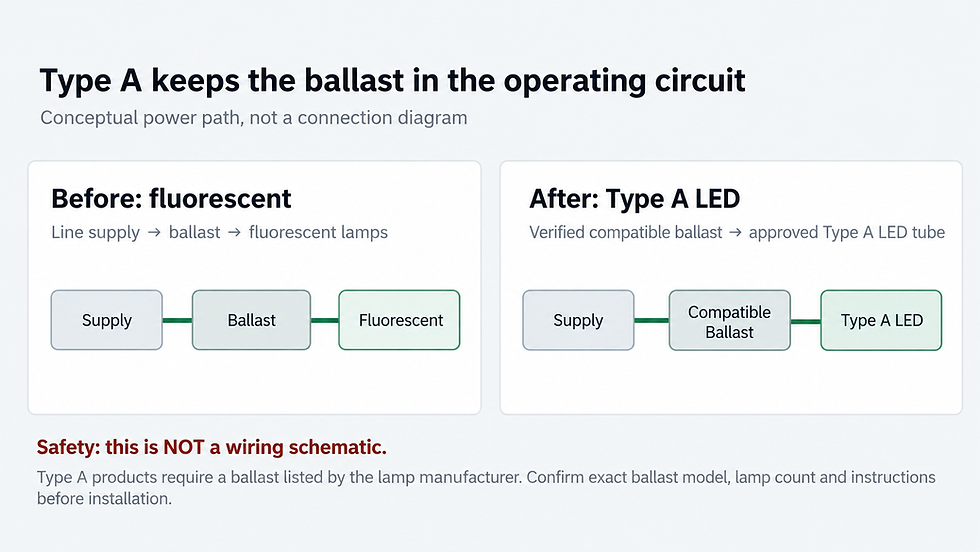
Our Type A vs Type B LED tubes guide covers compatibility lists, retained ballast cost and the practical trade-offs in more detail. The U.S. Department of Energy's troffer retrofit application guide also distinguishes lamp-only conversions from kits and new luminaires.
Option 2: Ballast-bypass LED tubes (Type B)
Type B tubes connect to the specified line-voltage supply after the fluorescent ballast is electrically bypassed. The installation scope includes safe isolation, checking supply voltage, modifying the fixture exactly as the listed retrofit instructions require, inspecting or replacing lampholders, and applying the required retrofit warning label. An installer should never assume a fluorescent lamp can be reinstalled in the converted luminaire.
Single-ended Type B supplies line and neutral at one end, generally requiring the specified non-shunted powered lampholder. Double-ended Type B uses opposite ends of the tube for line and neutral; which lampholders are allowed is product-specific. These descriptions are not wiring instructions. Have qualified personnel follow the actual manufacturer's diagram and local electrical rules.
Type B is frequently a strong commercial route where older ballasts are failing or a T12 housing is still mechanically sound. Removing a ballast from the operating circuit removes that maintenance dependency, but lamps, sockets, internal drivers and connections can still fail. Verify dimming, controls, emergency compatibility and the precise voltage range. A 120–277 V product cannot automatically be used on a 347 V circuit.
Best when: the existing luminaire is structurally sound but the project should retire obsolete ballasts. Include per-fixture conversion time, labels, testing, high-ceiling access and work in occupied areas in the quote. Fewer watts per fixture may reduce circuit load, but usable circuit capacity still depends on wiring, breaker ratings and applicable code.

Option 3: LED retrofit kits
An LED retrofit kit replaces the fluorescent lamps, ballast and selected internal components with new LED modules and driver equipment while retaining a usable fixture housing. For a recessed troffer, that can mean a new diffuser, trim or optical assembly without disturbing the ceiling grid. For a strip fixture, it may be an LED strip conversion assembly that installs inside the existing channel.
A well-designed kit can deliver more controlled distribution and a cleaner appearance than bare LED tubes inside a yellowed, lensed troffer. It can also reduce the risk of producing an uneven or visibly striped ceiling after an otherwise successful relamp. Compare actual lumens, distribution, glare, colour and light levels, not only input watts.
Select a certified kit approved for the host luminaire and install it according to its markings and instructions. UL Solutions explains that a certified conversion kit identifies appropriate host fixtures and installation conditions; the relevant U.S. standard is UL 1598C. Ensure the installer applies all supplied field labels.
Best when: the metal housing and ceiling are sound but reflectors, diffusers or appearance need a refresh. The owner gets much of the visual benefit of a new luminaire while avoiding unnecessary ceiling work. Check utility product qualifications before quoting incentives.
Option 4: New LED fixtures
A complete LED fixture replacement removes the fluorescent housing. Common commercial choices include 2 × 4 flat panels, recessed LED troffers, linear strips and gasketed vapor-tight fixtures. New luminaires give the designer the most control over optics, sealing, driver characteristics, warranty and integration with optional sensors.
A one-for-one replacement may deliver too much or too little light. Choose the fixture for the actual task and mounting height.
Best when: the housing is corroded or damaged, ceiling work is already scheduled, fixture locations are wrong or the facility needs a different lighting pattern. Changing fixture count or spacing? Start with our lighting layout calculator, then obtain a project-specific photometric study where necessary.
Cost, labour and savings by conversion route
The figures below are illustrative U.S. planning ranges in USD for one two-lamp, four-foot fixture, including ordinary material and labour but before rebates, tax, disposal and difficult access. They are not measured industry averages or confirmed LumaQuote default labour rates. Actual prices vary with access, labour market, product and scheduling.
Conversion route | Installed cost per fixture (USD) | Labour allowance | LED input per fixture | Ballast remains? | Incentive outlook | Best fit |
|---|---|---|---|---|---|---|
Type A tubes | $20–$45 | 5–10 min | Two 12–15 W tubes plus ballast input | Yes | May be limited; check program | Serviceable compatible electronic T8 ballast |
Type B tubes | $35–$75 | 10–20 min | Two 12–15 W tubes | No, bypassed | Product- and program-dependent | Older ballast, sound housing |
LED retrofit kit | $90–$180 | 20–35 min | 25–40 W | No | Often eligible if approved/listed | Sound housing, worn optics |
New LED fixture | $110–$250 | 30–50 min | 25–40 W | No | Often eligible if approved/listed | Damaged housing or new layout |
These allowances assume straightforward work at normal ceiling heights and exclude dedicated lifts, extensive socket replacement, failed wiring, hazardous-material remediation and unusual emergency systems. For Type A, the full system input includes the retained ballast; do not compare only the lamp label. See LumaQuote's fluorescent wattage reference for baseline system wattages. Adjust each fixture line from manufacturer documentation or measurements.
Compare total installed scope and expected operating life, not tube price alone.
Worked example: 100 troffers in an office
Assume an office has 100 two-lamp, four-foot T8 fixtures with 59 W existing complete-system input, operating 3,000 hours each year. Each is replaced with a 30 W Type B configuration. Electricity costs $0.13/kWh and the light levels are confirmed acceptable.
Input reduction: 100 × (59 W − 30 W) = 2,900 W, or 2.9 kW.
Annual energy savings: 2.9 kW × 3,000 h = 8,700 kWh/year.
Annual electricity savings: 8,700 × $0.13 = $1,131/year.
If the same office instead had two-lamp F34T12 fixtures drawing an assumed 72 W complete-system input, the annual saving would be 100 × (72 − 30) × 3,000 ÷ 1,000 = 12,600 kWh, or $1,638 at the same rate. An F40T12-based system can draw more; LumaQuote's published fluorescent reference uses 96 W for its generic two-lamp T12 category. Do not substitute 72 W for that fixture without checking its lamp-and-ballast combination. See why T12 fixtures can offer more savings per fixture.
These are energy-only examples, not full payback calculations. Installed cost, rebates, HVAC interactions, demand charges, dimming and maintenance need their own assumptions.
Run your actual fixture counts and electricity rates through the LED retrofit savings calculator.
Special cases: U-bends, 8 ft fixtures, 2 ft lamps, T5HO high bays and vapor tights
U-bend troffers
Verify the U-bend leg spacing, base, number of lamps and ballast. Straight-tube alternatives often require an approved conversion kit or complete fixture replacement, not just swapping in any similar-length tube. Check light distribution under the existing lens.
Eight-foot fixtures
Compare a listed eight-foot LED tube, a complete linear strip retrofit kit and an approved conversion to two four-foot lamps where the fixture and kit expressly permit it. Eight-foot slimline and high-output fluorescent products have different end contacts, so an ordinary four-foot G13 assumption is unsafe. Factor long-lamp shipping damage and handling into the selection.
Two-foot lamps
Short T8 and U-bend troffers may have higher fixture labour relative to lamp cost. Verify physical clearance and lens shadows, then compare a purpose-built two-foot kit or new 2 × 2 panel where permitted by the mounting system.
T5HO high bays
Replacing high-output fluorescent high bays demands attention to mounting height, aisle geometry, vertical illuminance and heat management. A generic low-power strip is not automatically an equivalent replacement. Compare performance with the high bay lighting calculator and request photometric modelling for racked warehouses.
Vapor-tight fixtures
In kitchens, parking structures, wash-down areas or damp facilities, preserve the environmental rating. A suitably rated new LED vapor-tight is often the simpler specification.
Don't lose emergency lighting
Some fluorescent fixtures contain an emergency ballast, unswitched feed or another connection to the building's egress lighting system. A standard Type A or Type B tube is not automatically compatible with that arrangement. Flag these fixtures during the audit rather than treating them as ordinary relamps.
The design may require a listed LED-compatible emergency driver or inverter, or a separate approved emergency luminaire. Test normal and emergency operation after installation, including required duration and applicable local inspection procedures.
Rebates for fluorescent to LED conversions
Lighting incentives change by utility, service territory, customer class, product type and program year. A rebate shown on last quarter's estimate is not an entitlement. The common routes are midstream discounts through a participating distributor, prescriptive incentives tied to eligible measures and custom incentives supported by project-specific calculations.
Type A lamp-only replacements may attract a smaller incentive or none under some programs, but never assume that Type B always qualifies. Kits and complete LED luminaires frequently need the exact model to be eligible, including appropriate DesignLights Consortium qualified-product status where required. Check requirements for minimum efficacy, controls, existing-fixture baseline, proof of purchase and installation date.
For territory-level guidance, start with commercial lighting rebates. Review the differences between midstream, prescriptive and custom incentives. When comparing a distributor discount with a reimbursement after completion, document upfront discounts versus post-project cash flow before quoting a net project price.
Lamp and ballast disposal
Fluorescent tubes contain mercury and require controlled handling. The U.S. EPA describes hazardous waste fluorescent lamps as eligible for the federal universal waste management framework, subject to state requirements. Keep spent lamps intact in appropriate closed containers, label them and use an authorized recycler. Do not assume dumpster disposal or on-site crushing is permitted.
Older magnetic ballasts require an additional check. EPA guidance notes that ballasts made before July 1979 may contain PCBs, while certain later non-PCB ballasts were required to bear a “No PCBs” label. An unlabelled ballast should not automatically be declared safe; establish its date and follow the applicable handling rules, particularly if it leaks.
Carry lamp recycling, ballast removal, hazardous-material exceptions and transport as visible quote items.
Are fluorescent lights being phased out?
Yes, in specific product categories and jurisdictions, but there is no single nationwide U.S. ban on every fluorescent lamp. Federal efficiency rules already removed many common T12 lamp-and-ballast combinations from new manufacture, while several states have since restricted sales of new linear fluorescent products. These laws generally regulate sale or distribution, not an automatic requirement to remove every installed luminaire on the effective date.
State | Restrictions on new linear fluorescent lamps | Primary source |
|---|---|---|
Vermont | January 1, 2024, for four-foot linear fluorescent lamps | |
California | January 1, 2025, for covered linear fluorescent lamps | |
Oregon | January 1, 2025, for covered linear fluorescent lamps | |
Illinois | January 1, 2027, for covered linear fluorescent lamps |
This is a selected, verified list, not an exhaustive inventory of states. Specialty exemptions and transitional provisions differ. For example, Illinois provides specific exceptions where an LED alternative is unavailable. Verify current statutory language and utility availability before setting a customer's procurement deadline.
Plan staged conversion instead of assuming replacement lamps will remain readily available.
Add controls while the ceiling is open
A planned fixture conversion can reduce the extra access and scheduling needed to add optional occupancy sensing, daylight response or dimming later. Specify controls only where space use and product compatibility justify them: review the commercial lighting control systems guide before adding an assumed control savings percentage.
From conversion plan to proposal
For a credible commercial bid, record each space once, identify each existing fixture configuration, then select Type A, Type B, a retrofit kit or a new luminaire for each line. Itemize lamps and hardware, installation hours, disposal, access, energy assumptions and eligible incentives.
LumaQuote helps move audited quantities, selected upgrades, labour and incentive assumptions into a consistent proposal. Review a sample lighting retrofit proposal to see how scope and savings can be presented without promising outcomes that have not been verified.

Try the savings calculator to compare scenarios, then Start free to build a project quote and proposal.
Frequently asked questions
How do I convert a 4 ft fluorescent light to LED?
Identify its fluorescent lamp type, ballast, socket configuration, voltage and fixture condition. Then choose a compatible Type A LED tube, a listed Type B conversion, an approved retrofit kit or a new fixture. Electrical conversions should be completed by qualified personnel to the exact manufacturer's instructions.
Can I just put LED tubes in a fluorescent fixture?
Only if the selected product is approved for that fixture and operating arrangement. Type A needs a compatible, serviceable ballast; Type B requires an approved electrical conversion. Physical fit alone does not establish safety or correct operation.
Do I need to remove the ballast to use LED tubes?
Not for a compatible Type A tube. For Type B, the fluorescent ballast must be bypassed as prescribed, and removal or physical retention depends on the listed conversion instructions. See Type A vs Type B LED tubes.
Can T8 LED tubes go in a T12 fixture?
They sometimes can after an approved ballast-bypass conversion, but not merely because a four-foot tube fits the same holders. Check the existing base, actual voltage and retrofit instructions. See T8 vs T12 compatibility.
How much does it cost to convert fluorescent to LED?
For a straightforward two-lamp, four-foot commercial fixture, the planning allowances in the comparison above range from about $20–$45 for compatible Type A tubes to $110–$250 for a complete new fixture in USD, before rebates and challenging site conditions. Quote actual products, local labour and disposal rather than treating these as guaranteed prices.
Is converting fluorescent to LED worth it?
Often, but not in every space. Payback depends on existing complete-system watts, proposed watts, operating hours, energy price, installation and maintenance. Use the LED retrofit savings calculator with defensible project assumptions.
Are fluorescent lights being banned?
Some U.S. states restrict sales of specified new fluorescent lamps, with effective dates and exemptions that differ. A sales restriction does not automatically require the removal of every existing fixture. See the state-specific dates above and check current local rules.


